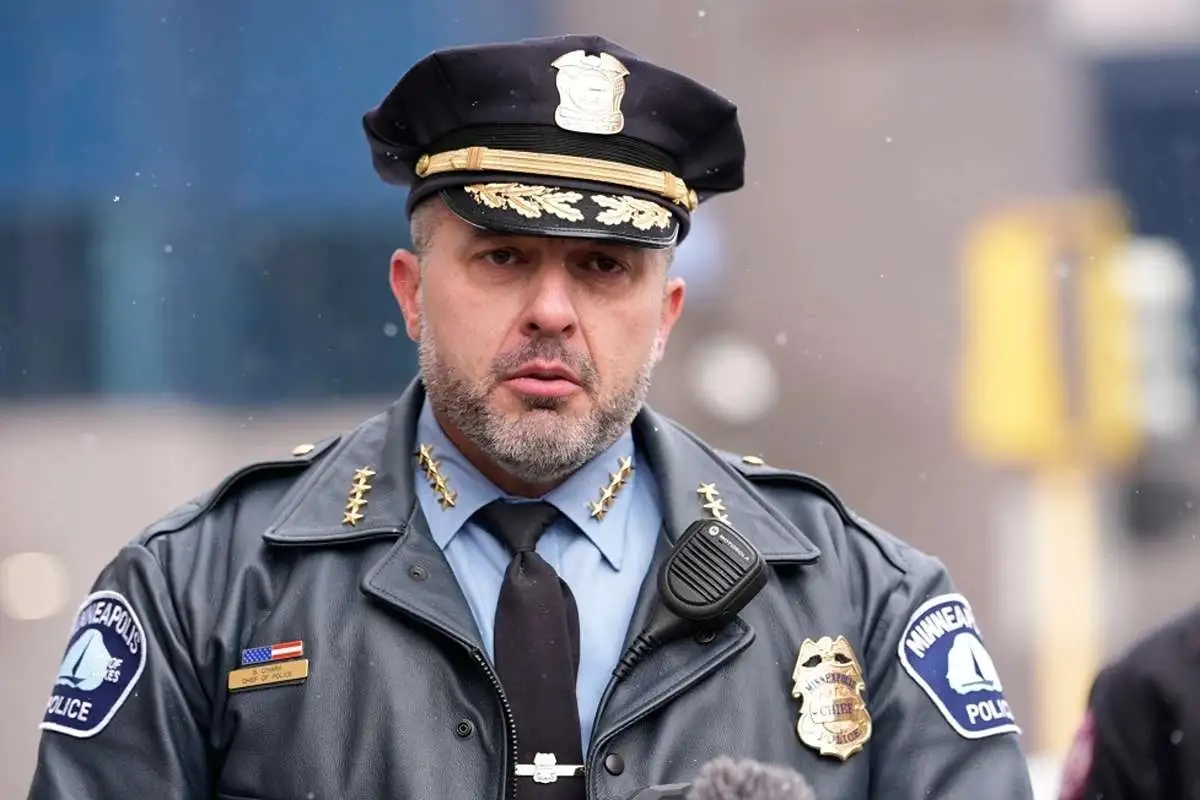
Minneapolis Police Chief Brian O’Hara resigned after an external investigation concluded that he interfered with an internal probe into allegations regarding his workplace conduct. Mayor Jacob Frey announced the resignation and stated that O’Hara stepped down after being informed he could face disciplinary action “up to and including discharge.” The resignation marked another major leadership shakeup for the Minneapolis Police Department during an already difficult period of reform and public scrutiny.
According to reports, the city launched an outside investigation in 2025 after allegations emerged that O’Hara had inappropriate relationships with city employees. Investigators ultimately did not substantiate the allegations involving intimate relationships. However, the investigation found that O’Hara interfered with the process itself by deleting a contact card from his city-issued cellphone and informing another city employee about the confidential investigation after he had been instructed not to discuss it.
Mayor Frey issued a written reprimand saying O’Hara’s conduct demonstrated poor judgment and undermined the integrity required for the role of police chief. Frey later said maintaining public trust was central to the decision and emphasized that “trust is not secondary to the job. It is the job.”
The resignation comes during a sensitive period for Minneapolis policing. O’Hara had been hired in 2022 to help oversee reforms following the killing of George Floyd and the nationwide reckoning over police brutality and racism. His departure now adds uncertainty to the city’s broader public safety leadership structure while reform efforts continue under court oversight and public pressure.
Investigation Findings Deepen Questions About Leadership
The investigation into O’Hara focused not only on the allegations themselves but also on how he responded once the inquiry began. Reports stated that investigators determined he attempted to shield evidence by deleting information from his city-issued phone. He was also accused of violating confidentiality instructions by discussing the investigation with another city employee despite direct orders not to do so.
Although investigators reportedly did not substantiate the claims of intimate relationships with city employees, officials emphasized that interference with the process alone raised serious concerns about leadership standards inside the department. Mayor Frey stated that the findings made it extraordinarily difficult for O’Hara to continue effectively serving as chief.
The resignation also came while additional complaints against O’Hara remained unresolved. According to the mayor’s office, 17 separate complaints involving O’Hara were still open at the time of his resignation, though officials declined to discuss their nature publicly.
Political tension surrounding O’Hara had already been building before the investigation became public. Some Minneapolis City Council members had questioned Mayor Frey’s decision to renominate O’Hara for another four-year term while rumors of investigations were circulating. Council President Elliott Payne criticized the renomination effort, calling it a major error in judgment given the seriousness of the allegations being examined.
The controversy further intensified debates about accountability, oversight and leadership within Minneapolis public safety agencies. Critics argued that city leadership had failed to fully stabilize the department even after years of reform efforts following Floyd’s death.
Reform and Public Tension Defined O’Hara’s Tenure
Brian O’Hara came to Minneapolis in 2022 after leading police reform efforts in Newark, New Jersey. City leaders selected him partly because of his experience managing reform processes during periods of intense public scrutiny. His appointment came as Minneapolis continued attempting to rebuild trust after George Floyd’s killing in 2020.
During his tenure, O’Hara oversaw several major crises and politically sensitive events. He managed law enforcement responses to the Annunciation Catholic School shooting and faced intense scrutiny during immigration enforcement operations connected to federal crackdowns under President Donald Trump’s administration. O’Hara publicly criticized some federal immigration tactics and warned that aggressive enforcement risked damaging community trust in local policing.
In interviews earlier this year, O’Hara expressed concern that tensions surrounding ICE operations could push Minneapolis toward another crisis point. He argued that aggressive immigration enforcement and confrontational tactics risked undermining years of effort to rebuild relationships between police and immigrant communities.
Despite those efforts, O’Hara faced criticism from multiple directions. Some activists accused Minneapolis police of cooperating too closely with federal immigration authorities, while others believed city leadership was obstructing law enforcement efforts. Reports also noted that complaints against O’Hara had increased substantially during debates over ICE activity in Minneapolis.
His resignation now leaves Minneapolis searching for another police chief during a period when the department remains under intense national attention. Assistant Chief Katie Blackwell has temporarily assumed leadership responsibilities while the city begins the search for a permanent replacement.
Broader Public Safety Leadership Faces Uncertainty
O’Hara’s resignation comes amid wider instability involving Minneapolis’ broader public safety structure. The city created the Office of Community Safety in 2022 to coordinate police reform efforts and develop alternatives to traditional policing following intense political battles over public safety after Floyd’s death.
However, tensions surrounding the Office of Community Safety have increased significantly in recent months. Several City Council members have expressed frustration with the agency’s performance, including concerns about budget management, oversight of police controversies and handling of violence interruption programs. Some council members even proposed pausing the search for permanent leadership positions while evaluating the agency’s overall direction and effectiveness.
Community Safety Commissioner Todd Barnette has also faced political opposition. Mayor Frey used veto powers to keep Barnette’s reconfirmation process alive after council resistance threatened his position. Reports suggested Barnette’s uncertain status was already viewed as a warning sign for O’Hara’s own renomination process before the investigation findings became public.
Mayor Frey nevertheless defended the city’s public safety reforms and insisted progress had been made despite continuing political disputes. He maintained support for Barnette even as O’Hara resigned and said Assistant Chief Blackwell was capable of stepping into the leadership role during the transition period.
The resignation therefore arrives at a particularly sensitive moment for Minneapolis. The city continues balancing police reform demands, public safety concerns, staffing shortages and political divisions while still operating under the long shadow of George Floyd’s murder and the nationwide movement it sparked.
Sources:
ABOUT AUTHOR
Ethan R. Calloway is an investigative journalist who lives in Washington, D.C. He is known for doing a lot of research on topics like holding the government accountable, corporate wrongdoing, and changing the criminal justice system in the United States.

# FinTech
TTEC launches a customized AI-human integrated platform that enable high-growth fintechs handle fraud, onboarding, and customer experience on a large scale.

# FinTech
Chime had solid results in the fourth quarter and finished moving its proprietary software stack.






Leave a Reply