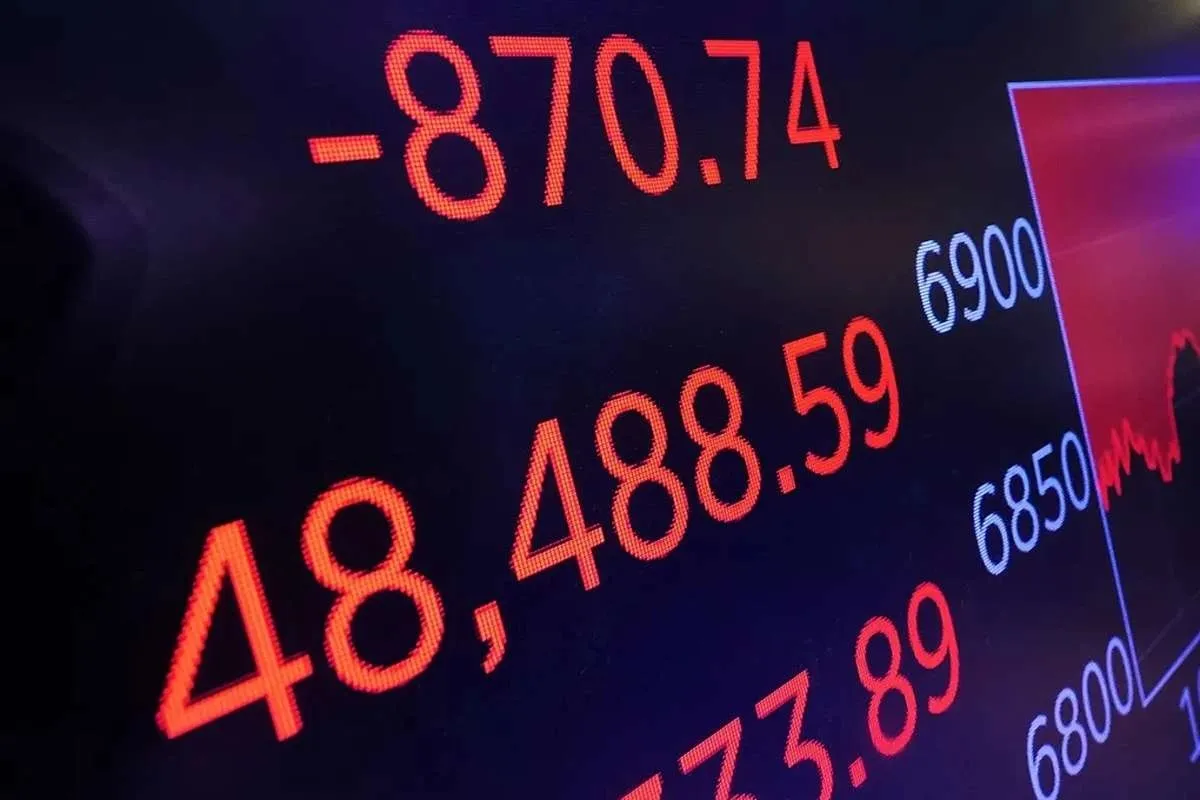
Stocks plummeted on Tuesday, the dollar sank for the second day in a row, and US Treasury costs rose to four-month highs after US President Donald Trump stepped up his efforts to take control of Greenland. Trump's warning of more tariffs on European nations if a deal on Greenland is not made has reignited talk of the 'Sell America' trade, which developed following his broad "Liberation Day" penalties in April.That transaction appeared to be gaining traction during Asian hours on Tuesday.Investors were also seeking safe-haven assets such as the Swiss franc and gold.The Nasdaq and S&P 500 futures fell over 1%, as the dollar weakened.The yield on the 10-year US Treasury note increased to 4.265%, the highest level since early September.
This is important because the markets are reacting to more than just trade issues.They are also reacting to worries about geopolitics, credibility, and the direction of policy. Donald Trump's renewed push for Greenland and the possibility of new tariffs on Europe is making people worry about a bigger "Sell America" trade, in which investors sell off U.S. assets, the currency, and Treasuries all at once. When there are problems with trade and threats to world peace, confidence can change very quickly, as shown by the big changes in stocks, bonds,and currencies.The effects are already clear in Europe and Japan, where stock markets are falling and borrowing costs are rising.The rise in gold prices shows that more people want to be safe.
European Stocks Set to Fall as Trump Trade Threats Weigh on Markets
European futures were down 0.27%, hinting to another gloomy start after the pan-European STOXX 600 lost 1.2% on Monday. MSCI's broadest index of Asia-Pacific shares outside Japan fell 0.24%, pulling away from its record highs set last week. European stocks are anticipated to open lower on Tuesday, as the threat of further trade penalties looms. The U.K.'s FTSE,Germany's DAX, and France's CAC 40 are all forecast to open approximately 0.2% lower, while Italy's FTSE MIB will open 0.26% lower. Regional bourses dipped on Monday as traders reacted to Trump's warning to impose taxes on European countries that oppose his ambition to buy Greenland.The dollar dominated currency markets. The dollar index was down 0.18% at 98.912.The Swiss franc reached a one-week high of 0.7956 per dollar after climbing 0.7% on Monday.The euro recovered from its lowest point since late November, while the sterling and Scandinavian currencies also rose.The Swiss franc posted its biggest daily gain against the dollar in over a month. In commodities, gold rose past $4,700 per ounce, setting yet another record and increasing its monthly advances to more than 9%.
Japan Stocks Slide as Bond Yields Hit Record High Ahead of Election
Japan's Nikkei lost 0.8%, while the yen was last unchanged at 158.08 per dollar, as investors anticipated next month's election, in which Prime Minister Sanae Takaichi will seek voter support for more spending and tax cuts. The primary action occurred in the bond market, as a selloff pushed Japanese government bond yields to record highs.Investors have been concerned about Japan's fiscal health since Takaichi took over as Prime Minister in October.On Tuesday, demand decreased at a 20-year JGB auction, and rates rose to a record high of 3.35%. "Soft demand at the 20-year JGB auction is the market asking for a bigger 'fiscal premium'," explained Saxo's Charu Chanana.According to Kyle Rodda of Capital.com, tensions may be self-limiting "if the markets send a signal that his actions are bad for investors and the economy." "But there's the risk that's not the case and we are heading for a potentially disruptive standoff between the U.S. and EU." "Even if there is de-escalation this episode will still cause many to doubt the credibility of any deal with Trump," said MUFG economist Henry Cook. Citi downgraded European shares to 'neutral' from 'overweight' following the recent escalation in tensions.
Davos in Focus as Trump Flags Greenland Talks and Trade Risks
All eyes will now be on Davos, where Trump stated the US will discuss acquiring Greenland. The focus on Tuesday will be on the World Economic Forum in Davos, with talks from Ursula von der Leyen, Emmanuel Macron, and China's vice premier.Trump is scheduled to address on Wednesday.Renewed tariff threats have rekindled fears about a potential "Sell America" trade.European shares sank more than 1%, while U.S. stock futures indicated pessimism.The action adds a geopolitical dimension to already high trade tensions. A fundamental concern is whether European investors might effectively cut their exposure to US assets. European investors own over $8 trillion in US equities and bonds, almost twice as much as the rest of the world combined. Analysts warned that alternatives to the dollar were limited.Capital Economics says that a 25% US tax could cut output in the UK and Germany by 0.2% to 0.3%. Between February and November 2025, German companies' investments in the United States fell by almost half. Barclays says that most countries in a global MSCI index have done better than the US so far in 2026.Analysts said that this kind of complacency could make markets more vulnerable if trade tensions get worse.
What to Watch Next
Investors will be very interested in what Trump says in Davos, especially if he gives any hints about whether the threats of tariffs are getting stronger or weaker. The markets will also be watching to see if European leaders really fight back or give in. Changes in the dollar, U.S. Treasury yields, and gold will be important signs of whether people become less willing to take risks. People in Asia will still be keeping an eye on Japan's bond market and politics as the elections get closer. The most important thing to ask is whether this event will go away or become another long-term shock to the confidence of the global market and trade.

ABOUT AUTHOR
Jordan M. Ellis is an American journalist and author who writes about the people and numbers in the economy, the stock market, and other areas.

# Banking
PNC Financial Services has said that it wants to open more than 300 new bank branches across the country by 2030.Learn what this growth means for people, communities, and the banking industry.
# Banking
Customers of Bank of America say that their mobile and online banking are down and that their balances are showing up as zero
# Banking
Federal Reserve is putting billions of dollars to U.S. banks every day to keep financing markets stable.






Leave a Reply