The question a rating answers
A company that issues a bond promises a stream of payments under a contract. The investor’s first question is whether the borrower can meet those obligations. A credit rating is a rating agency’s opinion about creditworthiness, expressed on a scale whose symbols vary by agency. It is one way of comparing borrowers or obligations using a common set of definitions. The SEC’s investor bulletin describes these ratings as opinions rather than assurances that the borrower will make every payment. Even a highly rated bond can suffer losses, and the letters on a screen do not describe the whole investment. [1] [2] [5]
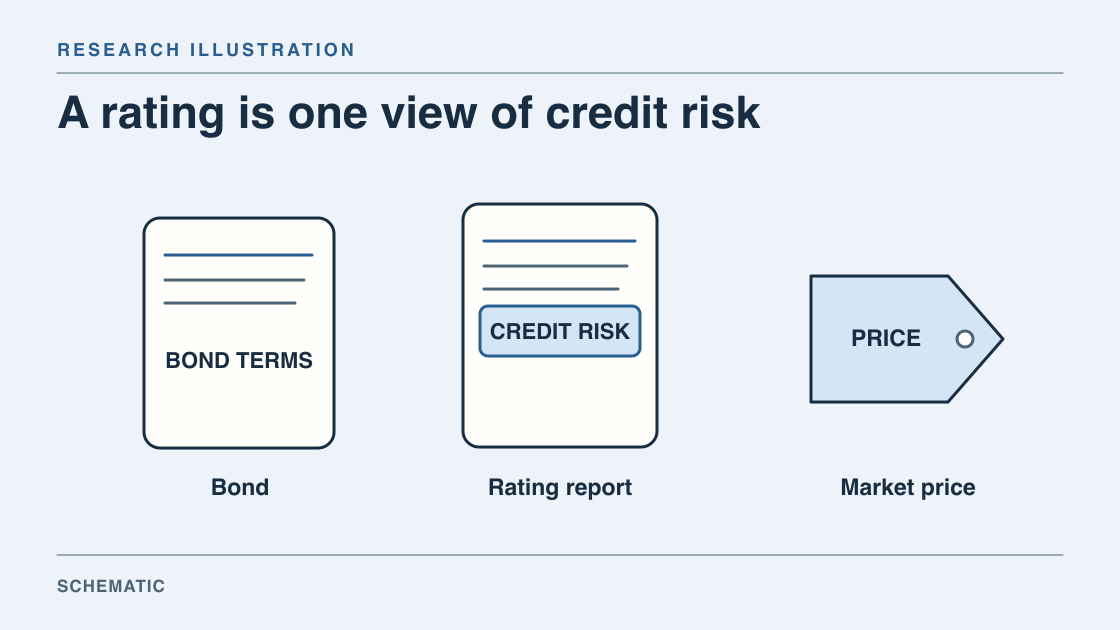
The distinction matters because the buyer pays a market price. A very strong borrower’s bond can trade below what an investor paid when broader interest rates rise. It can also be difficult to sell promptly at a favorable price if trading is thin. Those are different risks from a missed payment. A corporate bond can simultaneously carry low assessed credit risk, considerable sensitivity to market yields and limited liquidity. The rating addresses the first question. A quotation, transaction history and the terms of the security are better places to investigate the others. Keeping those questions separate makes it easier to understand why a rating and a price can move at different times. [1] [3] [5]
The borrower and the bond are separate
Two lines on the same screen can use the same letter format and describe different objects. An issuer credit rating evaluates the borrower under the agency’s definition. An issue rating evaluates a specific financial obligation. Under S&P’s methodology, the issue assessment can take account of features such as a guarantee, collateral or priority in the borrower’s capital structure. Those features can change what holders are likely to receive if the issuer cannot fully pay everyone. The useful first step in reading a rating notice is to identify the rated legal entity and the exact security. A group’s widely recognized brand can cover several different borrowers. [1] [2] [5]
Consider an illustrative manufacturer with a secured bond backed by specified assets and a subordinated bond that has a lower contractual claim. They depend on the same operating company, but their holders can face different recovery prospects if the company runs short of assets. Collateral value can change, and secured status alone does not promise full repayment. The actual priority, liens, guarantees and obligations of each entity are described in the securities documents. If a table shows different grades for two bonds issued by a group, that difference may reflect the contracts rather than a disagreement about the group’s operating performance. [2] [3] [5]
Read a bond in four layers
- Identify the rating
Check the agency, date and whether it rates the borrower or the specific bond.
- Read the contract
Find the payment terms, priority, collateral and call provisions.
- Compare the spread
Subtract an appropriate benchmark yield from the bond yield.
- Interpret the risks
Separate credit, interest-rate and trading risks when explaining a change.
How to read a rating scale
An agency’s definitions give meaning to the letters. On S&P’s long-term scale, BBB-minus is generally treated as the lowest investment-grade rating and BB-plus as the highest speculative-grade rating. Other agencies use their own symbols and terminology. The boundary is a category used in parts of the market, not a numerical promise of a certain return or a fixed annual probability of default. Two bonds with the same grade can have different maturities, protections and market prices. A meaningful comparison begins by checking the rating agency, the scale and the object being rated. [1] [2]
Ratings can change. Rating agencies can review an issuer after a material acquisition, a refinancing problem or a sustained change in cash generation. Agencies also publish outlooks or other signals under their own definitions. An outlook is distinct from the current grade, and different agencies may reach different judgments or update them on different dates. An investor reading about a downgrade can look at the rating action and the stated reasons, then check the issuer’s filings for the underlying events. The chronology is useful because the bond market may have reacted to the same information before the rating announcement. [1] [2] [3]
What a bond spread adds
A yield spread compares a bond’s yield with a reference yield. In a simplified example, a corporate bond yielding 5.60 percent and a comparable Treasury yielding 4.10 percent differ by 1.50 percentage points, or 150 basis points. A week later the corporate bond could yield 5.90 percent and the Treasury 4.40 percent, leaving the same spread despite the change in both yields. Comparisons depend on the benchmark and the bond features. For a plain fixed-rate comparison, similar maturities help keep the figures interpretable. An analyst may use a different spread measure when the bond has an embedded option. [3] [4] [5]
A spread is a market price signal and cannot be read as a direct default probability. Federal Reserve researchers decomposed corporate bond spreads in a model into a component associated with expected default and a residual they called the excess bond premium. The model illustrates one reason a spread can move even when the agency grade is unchanged. Investors may demand more or less compensation to bear credit risk. Any comparison can also be affected by trading conditions or the nature of the security being measured. The research method is a way of separating aggregate effects, and its residual is not an item printed on an individual bond’s statement. [3] [4]
Where the bond terms change the answer
A call provision gives the issuer an opportunity to redeem the debt under stated terms. This can change the period over which a buyer receives payments. FINRA describes why call features matter when evaluating yield. A quoted yield to maturity uses the scheduled payments through the bond’s stated maturity. A yield to call uses an earlier call date and the corresponding redemption price. Coupon, maturity and the call schedule can all affect how sensitive a bond’s price is to interest rates. Two bonds from the same issuer can therefore react differently to the same rate move. Reading the terms explains why identical letters need not produce identical price behavior. [3] [5] [6]
For a reproducible reading, start with the security identifier and confirm the latest issuer and issue rating. Then identify who owes the money, where the bond ranks, when it can be redeemed and what its quoted yield represents. Compare the yield with a suitable benchmark and keep the date of the quote alongside it. A later quote belongs to a different set of market conditions. This approach makes it possible to say precisely what has changed. It also keeps a useful agency judgment in its proper role as one input alongside the contract and the current terms of trade. [2] [3] [4] [5]
When an unrated bond enters the comparison
The absence of a public rating provides no grade to compare. A reader can still examine the borrower’s financial statements and the terms governing the issue, as FINRA’s due diligence guidance describes. Many of the same questions apply, including who is responsible for payments, how much other debt exists and whether the bond has safeguards or unusual redemption terms. The difference is that the reader cannot place an absent agency opinion on a rating scale. A quoted yield and a blank rating field are each limited evidence. [1] [3]
A rating also has a date and an institutional source. Some organizations rate issues using different assumptions, and the SEC encourages investors to understand how an agency reaches and uses its opinions. For a comparison between two bonds, recording the agency, date and scope is more useful than just copying the letters. That small amount of context makes the rating legible later, especially when the market quote has changed or one of the companies has issued new debt. An accurate description of the comparison begins with identifying what each measure covers. The resulting note can be checked against the offering document, the latest agency notice and the dated market quote. [1] [2] [3]
Frequently asked questions
Is an investment-grade bond guaranteed?
No. Investment grade describes a position on a credit rating scale. It does not guarantee payments or market value. [1] [2]
Can two bonds from the same issuer have different ratings?
Yes. Specific obligations can have different priority, collateral or guarantees, which the agency may consider in its issue rating. [2] [5]
Sources & further reading
- [1] SEC investor bulletin on credit ratings
Defines what ratings address, how different agencies express them and why they may change.
- [2] S&P Global Guide to Credit Rating Essentials
Describes the agency’s own scale and distinctions between issuer and issue ratings, seniority and recovery.
- [3] FINRA guide to bond due diligence
Explains how to inspect a bond’s documents, repayment features, risks and trading information.
- [4] Federal Reserve research on the excess bond premium
Separates expected-default and other components of corporate bond spreads in a research model.
- [5] SEC investor bulletin on corporate bonds
Explains corporate debt, payment priority and the difference between credit and other bond risks.
- [6] FINRA guide to corporate bond yields
Explains how yield to call uses a potential early redemption date and how that differs from yield to maturity.
Method & limitations
We compare SEC and FINRA investor guidance, S&P’s description of its own scale and Federal Reserve research on bond spreads. The spread and capital-structure examples use invented figures to isolate individual mechanisms.