One holding becomes two
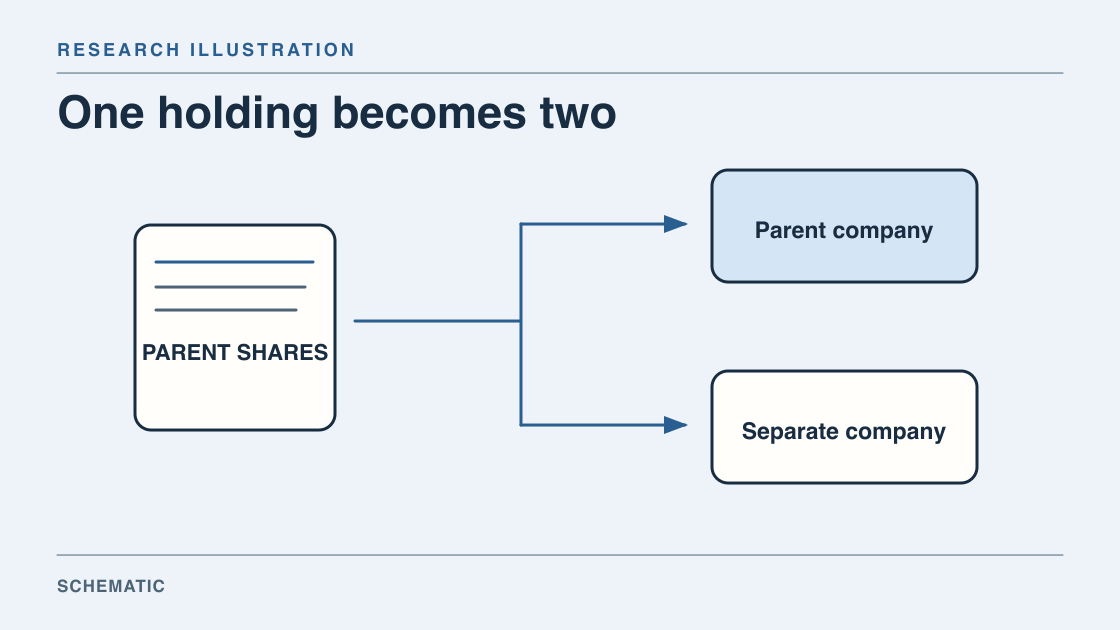
Imagine owning a piece of a public company whose engineering division and energy division sit under the same corporate roof. A conventional spin-off distributes shares of one business to the parent’s existing shareholders. The shareholders still hold their parent shares and receive a separate security for the business being spun off. When a distribution is pro rata, everyone who is entitled to it gets shares in proportion to their holdings under the published ratio. The SEC staff’s guidance describes a typical distribution in which those shareholders pay no consideration for the new shares. A cash sale to a buyer and an initial public offering both have different mechanics. [1] [2]
GE’s separation of its energy business provides a concrete example. The board approved the distribution in February 2024 and set March 19 as the record date. When the transaction took effect on April 2, GE distributed all outstanding GE Vernova shares and regular trading began on the New York Stock Exchange under GEV. A shareholder who held 80 GE shares through the distribution would have kept those shares and received 20 GE Vernova shares at the one-for-four ratio. The 80-to-20 calculation tells us nothing about the price of either stock after the separation. The two businesses are now priced separately. [3] [4] [6]
What the parent has to move
The visible event is a new line appearing in a brokerage account. The operational work starts earlier, when the companies decide what belongs to each side. An energy business may need employees, contracts, facilities, technology, bank accounts, legal entities and access to shared services. It may have liabilities tied to activities that took place years before the split. GE Vernova’s information statement describes a reorganization and a separation and distribution agreement that govern which assets and liabilities transfer and what responsibilities are allocated between the parties. The agreement and the legal entity structure help explain the economic perimeter much better than a list of the business’s brand names. [2]
A separate company can still rely on its old parent for a time. The GE Vernova information statement describes transition arrangements for some services and addresses topics such as taxes, employee matters and intellectual property in separate agreements. A service contract can help keep a business operating while it sets up its own systems. The duration and charges matter because historical expenses may reflect support inside the old company, while future expenses reflect contracts and the cost of standing up replacement functions. Readers can separate the operational question of whether a business runs on day one from the financial question of what it costs once temporary arrangements expire. [2]
From division to traded shares
- Define the business
Allocate assets, people, contracts and obligations between the companies.
- Set terms and dates
Disclose the distribution ratio, key dates and transaction conditions.
- Deliver the shares
Transfer the new shares to eligible parent-company shareholders.
- Report separately
Each public company reports on its own business after the separation.
The dates have different jobs
An announcement tells readers what the board intends to do and which conditions must still be met. The record date identifies the shareholder records used for the distribution. The distribution date is when the new shares are actually delivered under the announced terms. In the GE transaction, March 19 and April 2 were separate milestones. GE Vernova’s information statement also described two markets for GE shares around the split. In one, shares would trade with the right to the distribution. In the other, called ex-distribution, the seller would keep that right. The market in which the trade occurred mattered alongside the dates. [2] [3] [6]
The ratio can also produce a fraction. At GE’s published ratio, a hypothetical entitlement based on 81 parent shares works out to 20.25 new shares. GE’s shareholder material said that fractional shares would be aggregated and sold and the resulting proceeds distributed to the relevant holders. That makes the fractional line an operational detail with a real consequence. A shareholder could receive a whole-share allocation and a later cash amount. The treatment is a transaction term, so the example establishes what happened in this deal. A different distribution can use a different ratio or process for partial shares. [2] [6]
Read the standalone accounts
An information statement can contain two kinds of historical-looking numbers. Combined historical statements describe the business as it operated within the former parent, using the accounting perimeter and expense allocations explained in the notes. Unaudited pro forma statements illustrate how specified separation transactions would have changed a historical presentation under stated assumptions. In GE Vernova’s filing, those sections give readers different views of the separation. The footnotes are useful because a line item can look continuous across the split even when the way it is financed, allocated or supported has changed. The assumptions belong next to the number when comparing the periods. [2]
The parent’s figures change too. In its first-quarter 2024 report, GE said it would stop consolidating GE Vernova following the distribution and would present historical results from the relevant businesses as discontinued operations beginning in the second quarter. An apparent change in the parent’s reported revenue may therefore reflect a changed set of businesses in the accounts. The independent company’s subsequent filing describes its own consolidated presentation after the split. To make a like-for-like comparison, identify which businesses are inside each set of figures before calculating a growth rate, margin or debt ratio. This step also helps readers distinguish an accounting change from a deterioration in demand. [3] [4]
What changes for each business
Legal independence creates two separate places to look for decisions about financing, investment and dividends. GE Vernova’s information statement describes separate governance and the financing it expected to have available at separation. Historical operations inside a group may have depended on a parent’s cash or guarantees, so the opening balance sheet and financing disclosures are more informative than simply dividing the old group’s debt in proportion to revenue. The separation documents also help identify who stands behind obligations incurred before the distribution. For example, GE reported that some guarantees remained in place after the spin-off and that GE Vernova would work to replace or terminate them. [2] [3] [4]
The same reasoning applies to risk. A parent may have several unrelated sources of revenue that cushion a weak year in one division. The new public company reports its own exposures directly and has a different mix of businesses, contracts and customers. In GE Vernova’s case the filing describes the Power, Wind and Electrification segments and provides risks for the standalone company. A reader comparing the two companies can look at those exposures alongside the separation agreement instead of assuming an equal split of the parent’s old risks. [2] [3]
Why the tax documents come separately
The securities disclosure question and the tax question belong to separate frameworks. The SEC staff bulletin describes when the staff views Securities Act registration as unnecessary. The conditions include a pro rata distribution, adequate information for shareholders and the market, a valid business purpose, no consideration from shareholders and, if the subsidiary shares are restricted securities, a two-year holding period by the parent. GE separately said the separation was structured to be tax-free for U.S. federal income tax purposes. That characterization depends on the transaction and the circumstances described in the shareholder materials. The distribution announcement does not settle every holder’s treatment. Cash in lieu of a fraction and the holder’s jurisdiction can matter, which is why the tax discussion usually has its own section. [1] [2] [4] [6]
In U.S. reporting, an organizational action can change the basis of securities even when a holder does not send the company a payment. IRS instructions for Form 8937 describe when an issuer reports an action that changes a security’s basis, an amount used to calculate a taxable gain or loss. That is why deal materials may point to separate basis information after a split. The practical reading sequence is to find the information statement for the deal terms, the completion filing for what actually happened and the issuer’s tax materials for the transaction’s reported treatment. GE Vernova’s example shows why one press release rarely answers all three questions. It records a share count, but the rest of the documentation describes the businesses that emerged. [2] [4] [5] [6]
Frequently asked questions
Does a shareholder buy the new shares?
In the conventional pro rata structure described by SEC staff, the parent distributes the new shares without consideration from its holders. [1]
Can the parent and the new company still work together?
Yes. Transition service and other agreements can continue after legal separation. The information statement describes their terms. [2]
What happened to fractions in the GE Vernova deal?
GE’s materials describe an aggregation and sale process, with cash proceeds distributed to holders entitled to fractions. [6]
Sources & further reading
- [1] SEC Staff Legal Bulletin No. 4 on spin-offs
The SEC staff explains the features of a conventional pro rata spin-off and its approach to registration.
- [2] GE Vernova final information statement
The March 8, 2024 information statement describes the distribution, separation agreements, trading mechanics and standalone accounts.
- [3] GE Vernova Form S-1 amendment
The post-separation filing records the board approval, record date, ratio and April 2024 distribution.
- [4] GE first-quarter 2024 Form 10-Q
Note 24 confirms the completion date, listing and discontinued-operations accounting.
- [5] IRS Instructions for Form 8937
The instructions explain issuer reporting for organizational actions that affect the basis of securities.
- [6] GE Vernova spin-off shareholder FAQ
GE explains the share ratio, fractional-share handling and practical consequences for its shareholders.
Method & limitations
We compare SEC staff guidance, the final information statement, the completed GE Vernova transaction and IRS reporting instructions. GE Vernova is a documented U.S. example. The arithmetic is illustrative, and transaction terms and tax treatment vary.